Sea turtles face multiple threats both at sea and on the beaches where they nest. How can we protect these charismatic creatures?
The ancient mariners, sea turtles, now face multiple threats both at sea, where they spend most of their lives, and also on the beaches where they nest. Six of the seven species are threatened with extinction due to human activities.
Bycatch
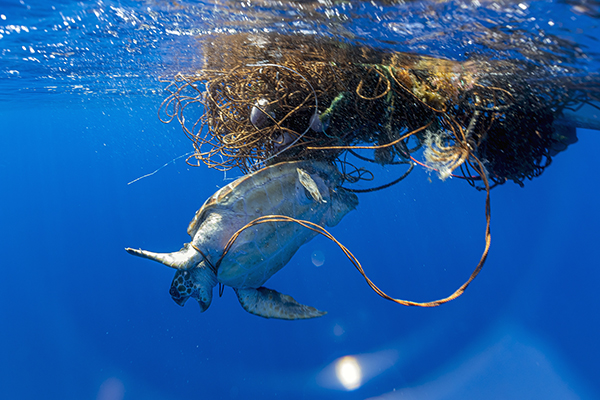
Conservation biologists say that fisheries bycatch – turtles caught in trawling fishing gear – is the greatest threat to sea turtle populations worldwide. Scientists estimate that fisheries have accidentally captured millions of sea turtles.
Pollution
Oil spills, chemical runoff and plastic pollution all impact sea turtles. As is true for all marine animals, sea turtles ingest a large quantity of plastic. Sea turtles encounter plastic debris at various stages throughout their life cycle and in a range of different habitats both near the coast and in the open ocean. The turtles that eat only jellies are in more danger of ingesting plastic because plastic debris often looks like a jellyfish. After analyzing autopsies, scientists found that nearly half of the sea turtles studied had eaten plastic. They found that both hard and soft plastics threaten turtles.
Coastal Development
Development of coastal areas where sea turtles breed and nest can impact sea turtles in many ways, including loss of beach habitat, disorientation from light pollution, and nest disturbance. Loss of beaches comes in many forms: beach development in the form of housing and hotels, sand mining, dredging of ship channels, and the construction of ports, and roads near nesting beaches.
Direct Take
For centuries in many parts of the world, people have depended on sea turtles for food and eggs. Some use shells for handicrafts and jewelry. Over the last 30 years alone, at least 1.1 million sea turtles have been illegally killed and exploited in 65 countries.
Climate Change
Rising sea levels, hotter temperatures and increased storm frequency caused by climate change all impact sea turtles. As sea level rises, the width of nesting beaches decreases and stronger storms erode suitable nesting habitats. Warming temperatures affect natural sex ratios, which are determined by nest incubation temperature.
Conservation Efforts
Conservation efforts focus on changing commercial fishing practices, understanding migratory and nesting behaviors, and hands-on help for the animals.
One of the first conservation efforts were turtle-exclusion devices (TEDs) in commercial shrimp fisheries. These “…promote sea turtle conservation by addressing interactions between sea turtles and trawl fishing gear. These devices are made of metal bars and mesh that fit inside the neck of a trawl net. While shrimp pass between the bars to the back of the net, turtles and other larger animals bump against the metal grid and escape through a flap in the mesh.”
To better protect sea turtles, it’s key to learn more about their migratory paths and behavior at sea. That’s why tagging turtles is so important. Satellite tags give scientists the story of individual turtles. You can see the migration tracks of some individual sea turtles here. And here.
In places all over the world, communities and organizations work to protect sea turtles. Here are just a few examples:
The Oceanic Society has a global network of people and organizations to support data collection, conservation and management of sea turtles. You can adopt and name a leatherback turtle (for a donation) and follow its migration.
Sea Turtle Conservancy has projects in Florida where it works on changing lighting that disorients turtles on nesting beaches. And in Costa Rica at Tortugera National Park, which has the largest green sea turtle nesting area in the Western Hemisphere scientists and volunteers monitor nesting trends, growth rates and reproductive success of green and also important nesting populations of leatherback and hawksbill turtles.
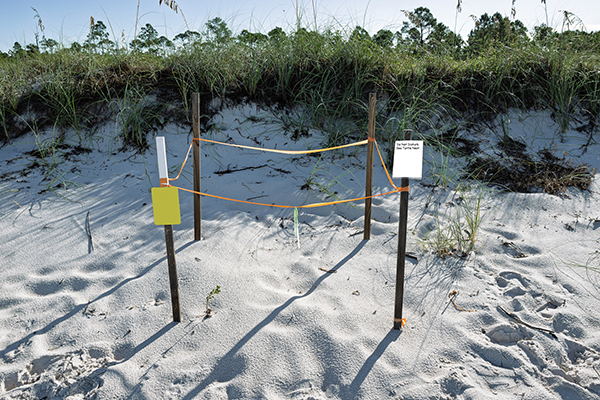
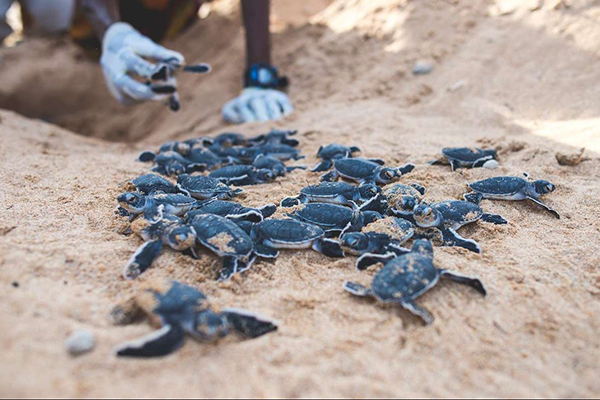
Tortuga Viva works to conserve native sea turtles along the coastline in Guerrero, Mexico. Local volunteers watch over olive ridley, leatherback and green sea turtle nests during their incubation period and then release hatchlings into the ocean. Tortuga Viva is hosted by Playa Viva where guests assist with hatchling releases and share their experience with family and friends.
Turtle Island Restoration Network protects sea turtles in several ways. They are trying to reform commercial fishery methods which kill turtles as bycatch. Working with community volunteers and partner organizations, they protect nesting females, eggs and baby sea turtles on beaches in places like Nicaragua, Texas, Costa Rica, Australia, and Papua New Guinea. And they’re focusing efforts on protecting leatherback sea turtles in the Pacific.
ShellBank is a “gamechanger pioneering marine turtle DNA-based traceability on a global scale. Unlike traditional tracking methods that focus on individual turtles, ShellBank’s approach enables DNA extraction from turtles, parts and products (e.g. eggs and tortoiseshell), to identify and trace a turtle’s population origin, its connectivity and geographic (transmigratory) boundary for conservation research and management or law enforcement purposes.”